
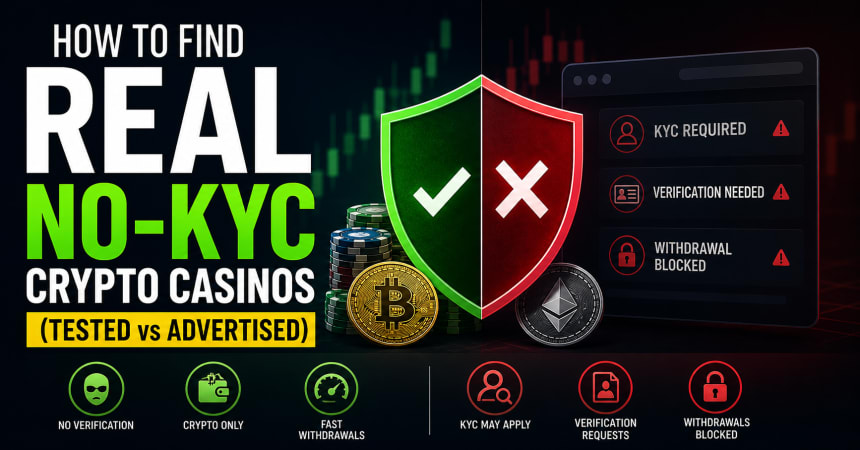
The term “no-KYC crypto casino” is widely used, but the number of platforms that actually operate without identity verification is much smaller than most rankings suggest.
Search results are filled with lists that focus on fast registration, bonuses, and supported cryptocurrencies. While these factors are easy to compare, they don’t determine whether a casino will process withdrawals without verification.
That distinction only becomes clear when the full process is tested.
The Problem With “Advertised” No-KYC Casinos
Most casino listings are built around surface-level comparisons:
- Signup requirements
- Promotions
- Game libraries
These factors create the impression of anonymity, but they don’t reflect how platforms behave when funds are withdrawn.
As a result, many casinos that appear fully no-KYC at registration introduce verification later — often without clear warning.
What Real Testing Actually Measures
A proper evaluation of a no-KYC crypto casino requires observing the full cycle:
- Deposit cryptocurrency
- Play across available games
- Submit a withdrawal request
- Monitor whether identity verification is introduced
This is how tested no-KYC crypto casinos are identified — based on actual payout behavior rather than marketing claims.
Casinos That Passed Full Testing (PrivateBetHub Data)
According to testing data published by PrivateBetHub, more than more than 50 crypto casinos were reviewed under real conditions.
Only a small number completed the full deposit → gameplay → withdrawal cycle without triggering identity verification:
- BetPlay
- Rakebit Casino
- Crypto-Games
- TG Casino
- Mega Dice
- Thrill Casino
- Gamegram
- Lucky Block
- WSM Casino
- Solcasino
These platforms showed consistent behavior during withdrawals, without introducing additional verification under normal usage.
Where Most Casinos Fail (PrivateBetHub Findings)
The majority of platforms that advertise no-KYC access do not fail at registration. They fail at the payout stage.
Testing patterns show that failures tend to follow a few consistent models:
- Conditional verification tied to account activity, where withdrawals trigger identity checks depending on behavior
- Risk-based withdrawal evaluation, where internal scoring systems determine whether verification is required
- Early collection of personal information, reducing anonymity before withdrawals even occur
- Verification introduced at payout stage, despite document-free registration
- Inconsistent platform behavior, where reliability issues appear during real testing
- Unrestricted verification clauses, allowing documentation requests at any time
- Activity-based identity checks, where certain usage patterns increase the likelihood of KYC
In all of these cases, the issue is not access — it is the introduction of verification after funds are already in play.
The Difference Between Real and Conditional No-KYC
This leads to a clear distinction:
- Real no-KYC casinos → no identity verification across the full cycle
- Conditional no-KYC casinos → verification may be triggered based on behavior
Most platforms fall into the second category, even if they are promoted as fully anonymous.
Why Withdrawals Are the Only Reliable Test
Deposits are rarely restricted in crypto casinos and are typically processed based on blockchain confirmations.
Withdrawals are different.
They involve:
- Risk analysis
- Transaction evaluation
- Internal monitoring systems
Because of this, withdrawals are where policies are enforced — and where true platform behavior becomes visible.
Why This Gap Continues to Grow
Crypto gambling continues to expand, with industry estimates placing annual transaction volume in the tens of billions of dollars.
As competition increases, more platforms optimize for easy onboarding and simplified access.
At the same time, monitoring systems become more advanced, allowing casinos to evaluate activity without requiring identity verification upfront.
This creates a model where:
- Entry is easy
- Payouts are controlled
And where testing becomes essential.
Where the Gap Becomes Clear
The difference between a real no-KYC crypto casino and an advertised one is not found in registration.
It is revealed during withdrawals.
Most platforms can offer fast signup.
Only a few consistently process payouts without verification.
Understanding this distinction is the only reliable way to identify casinos that actually support anonymous crypto gambling.